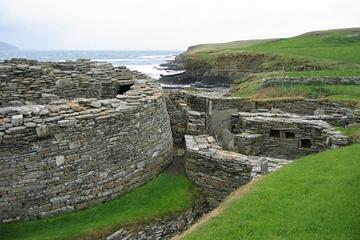
The Orkney Islands are an archipelago in northern Scotland, located just 10 mi (16 km) off the coast. While this cluster of islands is made up of approximately 70 islands, only 20 are inhabited, and they have been for over 8,000 years.
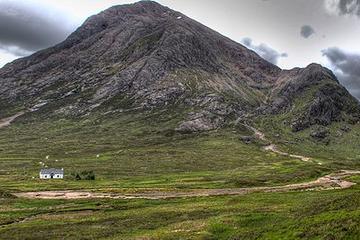
Glencoe offers some of the finest landscape in Scotland, indeed the whole of the UK, where dramatic mountains sweep down to glens (valleys) until they meet the moody waters of the lochs.
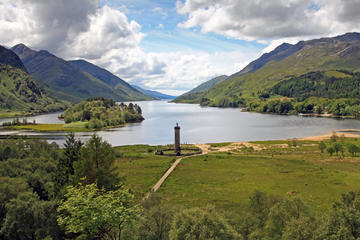
The Glenfinnan Monument stands in the village of Glenfinnan in the Lochaber area of the Scottish Highlands. It was erected in 1815 to commemorate the Jacobite Rising of 1745 that began in Glenfinnan when Prince Charles Edward Stuart raised his standard on the shores of Loch Shiel claiming the thrones of England and Scotland in the name of his father, James Stuart.
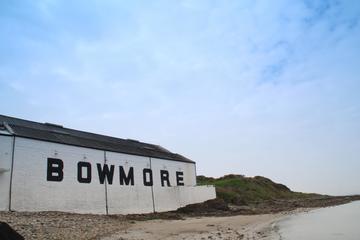
Founded back in 1779, the Bowmore Distillery holds the prestigious title of the Isle of Islay’s oldest distillery and the first of the island’s eight renowned distilleries is often the starting point for whisky-tasting tours. The distillery now has holiday cottages for guests onsite, as well as an award-winning visitor center and a tasting area within the legendary Bowmore No. 1 Vaults - the underground maturation warehouse, where the whisky is aged in oak casks.
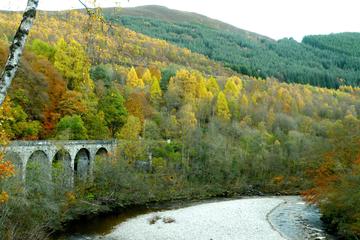
Killiecrankie is a small village near Pitlochry in Perthshire, sitting close to a wooded gorge formed by the River Gary in a region of spectacular Highland scenery. Close by is the National Trust for Scotland’s Killiecrankie Visitor Centre, nestled in the scenic Killiecrankie Pass and marking the site of an historic battle that took place on 27 July, 1689, during the first Jacobite Rebellion.
With its cobbled streets, narrow wynds, and old tollbooth on the shores of the Firth of Forth, Culross (pronounced Koo-ross) is said to be best-preserved 17th-century town in Scotland. Seventeen miles northwest of Edinburgh, Culross once thrived on the trade of coal and salt, but when the coal dried up, so did the prosperity of the town, and so the original merchant’s houses were never demolished or tweaked into Victorian builds.
Holy Island is located in Lamlash Bay off the Isle of Arran on Scotland's western coast. The island has a spiritual heritage dating back to the 6th century. Today there is the Centre for World Peace and Health on the north end of the island which has ongoing retreat programs and courses.
Flanked by the Lomond Hills in central Fife, the former royal burgh of Falkland is known for its twisting streets and centuries-old stoned houses. Dominating the town center is the famous Falkland Palace. Once the hunting lodge of the Stuart Monarchs, the palace was a favorite summer resort of Mary Queen of Scots.
Founded in the 4th century, the Scottish town of St Andrews is known for being home to Scotland's oldest university as well as for being the "golf capital of the world." Set on a wide bay on the northeast coast of Fife, the seaside town is surrounded by white sand beaches, including the famous West Sands.
Laying claim to the world’s oldest golf course and boasting a history of the game that dates back to the 15th century, the coastal town of St Andrews has long been renowned as the ‘home of golf’ and it’s still Scotland’s premium destination for international golfers. The St Andrews Links – the local lingo for ‘golf courses’ – include 7 public courses, sited in dramatic settings along the coastal cliffs and preserved by the St Andrews Links Trust.
Along with Calton Hill and Castle Rock, Arthur's Seat forms part of the ridge of cold volcanoes that give such drama to the Edinburgh skyline. The mountain sits in Holyrood Park, 650 acres (260 hectares) of wild parkland just a short walk from the Royal Mile. So you can be shopping for Argyle socks one moment and roaming around lochs and moorland the next! From some angles, the mini-mountain resembles a sleeping lion. It’s perhaps seen at its best in the mellow light of sunset.
Linlithgow Palace is the classic romantic ruin, steeped in royal history and set beside a picturesque loch. It was begun in 1424 on the site of another palace that burnt down. Its halcyon period was during the reign of the Stuarts, who used it as a pleasure palace; it was particularly popular amongst the queens. Mary Queen of Scots and Elizabeth I lived there as babies.
The Palace of Holyrood House, most often called Holyrood Palace, faces Edinburgh Castle along the length of the Royal Mile. Like its majestic companion, it's riddled with some of Scotland's most potent history.
Look up anywhere in Edinburgh's old town and you'll see Edinburgh Castle, seeming to grow out of the blackened cold volcano that forms its plinth. There's evidence of human habitation on this spot that dates back to 900 BC, and the Castle has been a royal stronghold since the Middle Ages.
Gracious Princes Street, with its epic length, gardens, stellar shopping, and knockout views, is the central vein of Edinburgh and one of Europe's great thoroughfares. It’s also at the center of the city’s world-famous Hogmanay (New Year’s Eve) celebrations, which revolve around a massive street party. If you’re newly arrived in Edinburgh, a stroll along it is one of the finest ways to orient yourself.
The oldest house in Glasgow, the eccentrically named Provand's Lordship was built in 1471 for the chaplain of St Nicholas Hospital. The city's only medieval building to avoid the wrecking ball, the house is now a museum. It's a fascinating place to see period details in situ, from 16th-century furnishings to a 20th-century sweet shop.
A multimedia mixed bag of paintings, ceramics, furniture and sculpture come together at the Gallery of Modern Art, one of Britain’s most popular contemporary art museums. Temporary exhibits mix with the fine permanent collection of works by the likes of Hockney and Warhol.
In a country of castles, Stirling Castle may just be the ultimate royal stronghold. In fact, it was once rumored to be the home of King Arthur and his knights. Like Edinburgh Castle, Stirling Castle dominates the surroundings, looming over it from a plug of volcanic rock.
Bookended by Edinburgh Castle and Holyrood Palace, the Royal Mile (it's actually slightly longer than a mile) is the grand center of Edinburgh's Old Town. The Royal Mile is dominated by granite, giving it a dark, Gothic feel, and lined with majestic buildings - banks, churches, courthouses.
Most visitors to The Isle of Skye tend to stick to the beaten track, but it won’t take you long to explore your own favourite part of this paradise. When the sun's out Skye is enchanting, with its vivid blue lochs, seas glittering in the light and its green crags glowing.